Clothes Dryer Fire Prevention: A Practical Home Safety Guide
Here is a home-safety invitation from The Lint King: look beyond the lint filter. A conventional vented dryer depends on a clear exhaust path outdoors. That path is central to our Northern Illinois work.
Why Clothes Dryer Fire Prevention Matters
A conventional vented dryer uses heat and moving air as fabrics release lint. Most lint reaches the filter, but some can enter the cabinet, connector, and concealed exhaust duct. A restriction slows the escape of humid air and may allow heat to build. Ventless condenser and heat-pump dryers work differently; follow their manuals.
The United States Fire Administration (USFA) reports that failure to clean was the leading factor contributing to ignition in 31 percent of home clothes dryer fires from 2018 through 2020.[1] Because reporting periods change, check the official source for updates.
xychart
accTitle: Failure to clean as a leading factor in home clothes dryer fires
accDescr: Failure to clean was the leading factor contributing to ignition in 31 percent of reported home clothes dryer fires from 2018 through 2020.
title "Failure to clean as a factor contributing to ignition"
x-axis ["2018–2020"]
y-axis "Percent of reported fires" 0 --> 100
bar [31]
What the Hoffman Estates Fire Teaches Homeowners
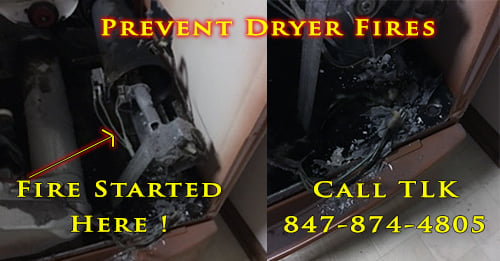
A Hoffman Estates dryer fire provides a Northern Illinois example. A 2016 Daily Herald report said residents evacuated before firefighters arrived. Officials determined that lint buildup in the dryer venting hose and piping started the fire.[2]
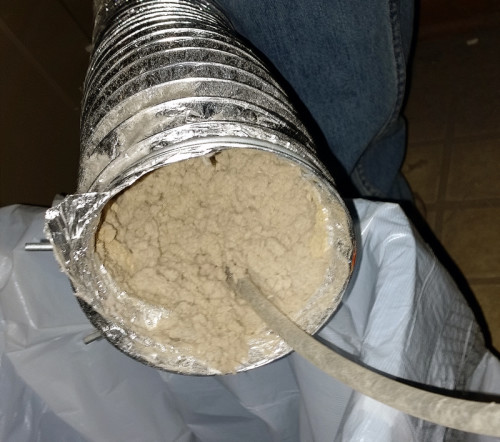
Although the fire occurred in 2016, its lesson still applies. The report’s “hose and piping” wording points to the transition connection and the longer duct. Cleaning the lint filter does not examine those sections or the outdoor termination.
That distinction matters because lint can collect beyond the screen, where a homeowner may not see it during laundry or routine cleaning.
How the Dryer Exhaust Path Works
First, the dryer moves heated air through tumbling laundry. Next, the air carries moisture and lint past the filter into the transition duct, the short connection behind the dryer. Then it enters the home’s permanent duct and exits through an outdoor hood or roof termination.
| Exhaust part | What to observe | Possible concern |
|---|---|---|
| Lint filter | Clean, intact, and seated correctly | Heavy coating, damage, or a missing filter |
| Transition duct | Secure metal connection with room behind the dryer | Kinks, crushing, disconnection, or unsuitable material |
| Permanent duct | A route that follows the dryer manual and local requirements | Lint buildup, damage, loose joints, or too many restrictive turns |
| Outdoor termination | Damper opens and exhaust air escapes during operation | Weak movement, lint, debris, nesting material, or a clogging screen |
How to Apply the Local Lesson at Home
Clean the Lint Filter After Every Load
Remove lint after every load and reinstall the filter securely. ENERGY STAR says this supports air circulation and dryer efficiency, while also serving as an important safety measure.[3] Never run the dryer without its correct filter.
Inspect the screen occasionally. ENERGY STAR notes that dryer-sheet residue can coat a filter and reduce airflow.[3] Follow the appliance manufacturer’s cleaning instructions, and replace a torn, warped, or poorly fitting filter with the correct part.
Protect the Vent Connection and Outdoor Outlet
Do not push the dryer tightly against the wall, where its transition duct can flatten. The United States Consumer Product Safety Commission (CPSC) advises replacing plastic or foil accordion-style ducting with rigid or corrugated semi-rigid metal; accordion material can trap lint and kink or crush easily.[4] UL Solutions also recognizes properly listed flexible metal transition ducts.[5] Use only material allowed by the dryer manufacturer and local requirements.
From a safe position, check whether the exterior damper, or moving flap, opens while the dryer runs. Keep leaves, snow, and debris away. Do not add a lint-catching screen. Never reach an elevated outlet unsafely.
Stay Home and Awake While the Dryer Runs
Run the dryer only when someone is home and awake.[6] That makes it easier to notice an unusual odor, sound, alarm, or shutdown. It lets you respond promptly instead of allowing a problem to continue unnoticed. Avoid overloading, use the proper cycle, and follow garment-care labels and the appliance manual.
Handle Special Laundry Carefully
Never machine-wash or machine-dry clothing contaminated by gasoline or another flammable liquid. CPSC advises spot-cleaning and line-drying those items because invisible vapors can ignite.[7] For cooking oil, cleaning products, or finishing products, follow the product label, garment-care label, and dryer manual. When any instruction says to keep an item away from heat, do not place it in the dryer.
Keep cardboard boxes, clothing piles, cleaning supplies, and other combustible items away from the dryer. Plug major appliances directly into suitable wall outlets rather than extension cords.[1] Stop using the dryer if you see a damaged cord, scorched outlet, or sparking. Arrange inspection by the appropriate qualified professional.
Know the Warning Signs
One slow load does not prove the vent is clogged. Heavy towels, an overloaded drum, a weak washer spin, or humid conditions can increase drying time. Instead, look for a persistent change from your dryer’s normal performance.
- Loads repeatedly need another cycle.
- Clothing or the laundry area feels unusually hot.
- A burning, hot-lint, or unfamiliar odor appears.
- The dryer stops early or displays an airflow warning.
- Lint gathers behind the machine or around the outdoor hood.
- The outdoor damper barely opens, or airflow seems weaker than usual.
These symptoms can come from a vent restriction, an appliance problem, or both. Stop immediately for a burning odor or severe heat. For smoke, flames, sparking, or gas odor, leave the home and call 911 from a safe place. Repeated slow drying or weak airflow deserves evaluation before another load. A qualified dryer-vent professional can evaluate the exhaust path, while an appliance technician can diagnose internal components. The 5 Signs You Need Dryer Vent Cleaning guide explains these clues in more detail.
A Routine for the Complete Dryer Exhaust Path
A routine connects each task to a moment you recognize. Keep this checklist with your home-maintenance records and share it with everyone who uses the dryer.
| When | What to do | Why it helps |
|---|---|---|
| After every load | Clean and securely replace the lint filter. | Supports airflow through the appliance. |
| During laundry-room cleaning | Remove accessible lint and keep the dryer area clear. | Reduces material near a heat-producing appliance. |
| While the dryer operates | Notice time, heat, odors, sounds, and outside airflow. | Helps you recognize a meaningful change. |
| Once a year | Have the vent ductwork cleaned, following manufacturer guidance and home conditions. | Addresses buildup beyond the lint filter.[8] |
| When slow drying or weak airflow repeats | Stop and arrange vent service or appliance repair before reuse. | Prevents repeated operation with an unresolved problem. |
Annual cleaning is a useful baseline from USFA, not a promise that every home can wait exactly one year. Laundry volume, pets, vent length, bends, duct condition, and the outdoor termination can change the needed interval. Follow the dryer manual and respond sooner when performance changes. For an overview of longer routes and airflow resistance, read Dryer Vent Static Pressure, Airflow, and Duct Code: A Homeowner’s Guide.
A Decision Flow for Each Dryer Load
flowchart TD
accTitle: Clothes dryer fire-prevention decision flow
accDescr: Clean the lint filter, operate the dryer while home and awake, leave and call 911 for smoke, flames, sparks, or gas odor, and stop the dryer for burning odor, severe heat, or performance changes.
A["Clean and reinstall the lint filter"] --> B["Run the dryer while home and awake"]
B --> C{"Smoke, flames, sparks, or gas odor?"}
C -- "Yes" --> D["Leave, stay outside, and call 911"]
C -- "No" --> E{"Burning odor or severe heat?"}
E -- "Yes" --> F["Stop using the dryer and arrange qualified inspection"]
E -- "No" --> G{"Slow drying or weak airflow?"}
G -- "No" --> H["Finish the cycle and keep the area clear"]
G -- "Yes" --> I["Stop and arrange qualified evaluation"]
If You See Smoke or Flames
Treat smoke, flames, or a sounding alarm as an emergency. Do not open the dryer door to investigate; a National Fire Protection Association (NFPA) research report advises that opening it can add oxygen and worsen the fire.[9] Get everyone outside, stay outside, and call 911 from a safe place. Do not delay evacuation to move or unplug the appliance.
Working smoke alarms provide warning. USFA recommends alarms in every bedroom, outside each separate sleeping area, and on every level, including the basement. Test them monthly and follow the manufacturer’s replacement instructions.[10] Review and practice a household escape plan as well.
What Professional Dryer Vent Cleaning Addresses
A professional visit should address the route, not only the lint visible at the dryer. The technician may inspect the connection, clean accumulated lint and debris from the duct, clear the accessible outdoor termination, and identify damaged or unsuitable components. UL Solutions notes that inspection frequency depends on dryer use, the duct’s length, turns, and shape, and the dryer’s age and type.[5]
What to Share Before an Appointment
- Whether the dryer is gas or electric, stacked, or inside a tight closet
- Where the vent exits, such as a side wall or roof
- Any longer drying, high heat, odor, shutdown, or airflow warning
- Whether the unit or connector was recently moved or replaced
- When the complete exhaust path was last inspected or cleaned
This information helps the service provider understand access and bring suitable equipment. The Dryer Vent Cleaning Guide for Safer, Faster Drying explains the process, while Dryer Vent Cleaning Costs describes current service ranges and factors. Because prices and availability can change, check the official pages before booking.
Related The Lint King Pages and Posts
- 7 Practical Ways to Prevent Dryer Fires at Home
- Clothes Dryer Fire Prevention Tips
- The Importance of Regular Dryer Vent Cleaning
Make the Next Load a Safer One
Dryer fire prevention begins with manageable habits. Clean the filter, keep the exhaust route in good condition, remain home and awake, and take changes seriously. You do not need to diagnose every problem yourself. You only need to recognize when normal drying has changed and choose a safe next step.
If drying takes longer, outside airflow appears weak, or the vent is due for attention, Schedule A Dryer Vent Cleaning with The Lint King. We will help you understand the vent’s condition and the practical options for your Northern Illinois home.
Suggested WordPress Details
| Title | Clothes Dryer Fire Prevention: A Practical Home Safety Guide |
|---|---|
| Category | Dryer Vent Cleaning Education |
| Tags | Clothes Dryer Fire Prevention, Dryer Vent Safety, Laundry Room Safety, Dryer Vent Cleaning, Northern Illinois Home Safety |
| Excerpt | Learn practical clothes dryer fire-prevention habits, recognize warning signs, protect airflow, and know when to arrange professional dryer vent cleaning. |
| Suggested Image | A realistic 16:9 Northern Illinois laundry room showing a homeowner cleaning an intact lint filter beside a properly connected metal dryer transition duct. Include a small, clear view of an outdoor vent damper opening normally. Do not show flames, smoke, extreme lint piles, unsafe appliance movement, plastic ducting, invented statistics, or unsupported safety claims. Suggested alt text: “Homeowner cleans a dryer lint filter as part of a practical clothes dryer fire-prevention routine.” |
References
- Appliance and Electrical Fire Safety. U.S. Fire Administration. Accessed September 4, 2026. Full URL:
https://www.usfa.fema.gov/prevention/home-fires/prevent-fires/appliance-and-electrical/↩ - Hoffman Estates dryer fire causes $15,000 in damages. Daily Herald. Accessed September 4, 2026. Full URL:
https://www.dailyherald.com/20160822/news/hoffman-estates-dryer-fire-causes-15000-in-damages/↩ - Clothes Dryers. ENERGY STAR, U.S. Environmental Protection Agency. Accessed September 4, 2026. Full URL:
https://www.energystar.gov/products/clothes_dryers↩ - Overheated Clothes Dryers Can Cause Fires. U.S. Consumer Product Safety Commission. Accessed September 4, 2026. Full URL:
https://www.cpsc.gov/s3fs-public/5022.pdf↩ - Mitigating Clothes Dryer Fires. UL Solutions. Accessed September 4, 2026. Full URL:
https://www.ul.com/news/mitigating-clothes-dryer-fires↩ - Clothes Dryer Fires in Residential Buildings (2008–2010). U.S. Fire Administration. Accessed September 4, 2026. Full URL:
https://www.usfa.fema.gov/downloads/pdf/statistics/v13i7.pdf↩ - Don’t Get Burned: Flammable Liquid Vapors Are Invisible, Explosive and Unpredictable. U.S. Consumer Product Safety Commission. Accessed September 4, 2026. Full URL:
https://www.cpsc.gov/s3fs-public/5140.pdf↩ - Basement and Garage Fire Safety. U.S. Fire Administration. Accessed September 4, 2026. Full URL:
https://www.usfa.fema.gov/prevention/home-fires/prevent-fires/basement-and-garage/↩ - Home Fires Involving Clothes Dryers and Washing Machines. National Fire Protection Association. Accessed September 4, 2026. Full URL:
https://content.nfpa.org/-/media/Project/Storefront/Catalog/Files/Research/NFPA-Research/US-Fire-Problem/Fire-causes/oswashersdryers.pdf?rev=a2ca193e4d3f4852973805277ce91d05↩ - Smoke Alarms. U.S. Fire Administration. Accessed September 4, 2026. Full URL:
https://www.usfa.fema.gov/prevention/home-fires/prepare-for-fire/smoke-alarms/↩